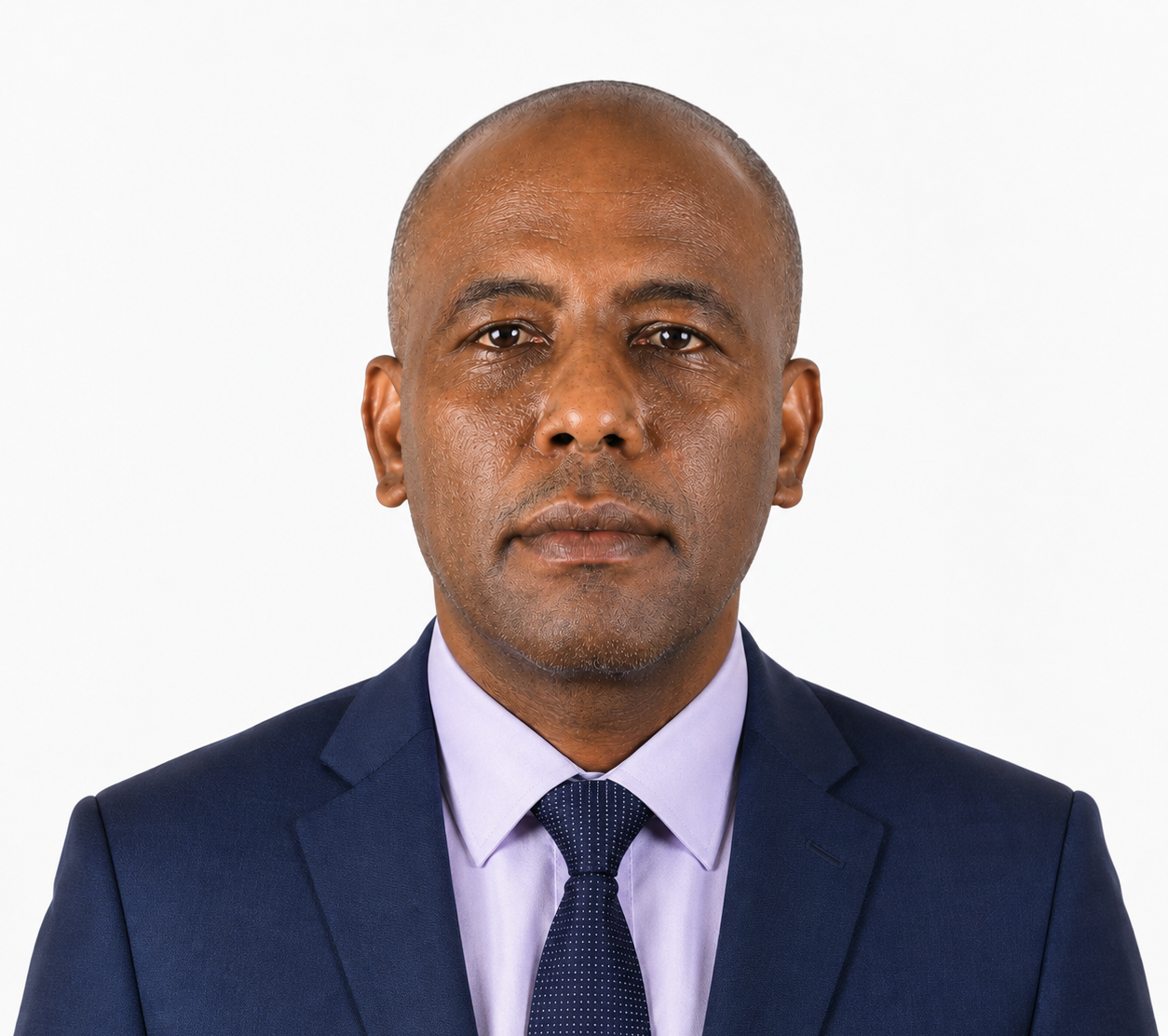
Hydraulic Engineering Across the Water Cycle
Eng. Tamir Mitiku Habeteyes is a hydraulic and hydropower engineer, irrigation engineer, and water-supply, sanitation and wastewater professional whose career has progressively expanded across almost the complete spectrum of water infrastructure.
Over more than twenty-five years of professional practice, his work has encompassed irrigation planning and design, groundwater development, pumping and conveyance systems, hydraulic structures, large-scale irrigated agriculture, urban water supply, sanitation, wastewater and fecal-sludge treatment, construction supervision, project coordination, procurement, contract administration, commissioning, operation and institutional development.
He holds a Master of Science degree in Hydraulic and Hydropower Engineering and a Bachelor of Science degree in Irrigation Engineering. He is registered in Ethiopia as a Practicing Professional Hydraulic and Hydropower Engineer. His continuing professional development includes World Bank contract management, ArcGIS and hydraulic modelling, wastewater and fecal-sludge management, sewerage-system design, project management, procurement, environmental and social impact assessment, water-resources planning and management, AutoCAD, KAIZEN and risk management.
Where Integrated Water Engineering Began
The HARE Irrigation Project Design Report marks an important beginning in Eng. Tamir's professional journey. In 1995, he joined Mesfin Hagos, Mitiku Bedru and Seid Shimelis in preparing the project as part of their engineering studies at the Arba Minch Water Technology Institute.
The work required the young engineers to address irrigation-water quality, crop-water requirements, hydrology, canal hydraulics, diversion structures and irrigation-infrastructure design, providing an early practical foundation for a career that would remain centred on water engineering.
From Small-Scale Irrigation to Urban Water Systems
Eng. Tamir began his professional career in 1996 as an Irrigation Engineer with the South Region Water Resources Development Bureau in Hadiya Zone. His work included reconnaissance, planning and design of small-scale irrigation schemes, project management and technical support to organisations and NGOs. This included the Ameca and other small-scale irrigation projects in Hadiya Zone, covering approximately 1,200 hectares of farmland under furrow irrigation and involving design review, construction inspection and follow-up.
From 1999 to 2005, his responsibilities broadened substantially when he served as Water Supply and Sanitation Study and Design Team Leader. His work covered feasibility studies, pressure mains, distribution networks, submersible pumps, power requirements, hydraulic structures, cost estimates, specifications, tender documents, tender evaluation, contract-award processes, project scheduling and verification of as-built records. Under his technical leadership, reliable water-supply infrastructure was established for more than ten rural towns and three major urban centres.
He subsequently served as a Sanitary Engineer and later as Head of Construction Supervision and Registration, providing technical advice, construction inspection, quality control, progress monitoring, supervision of water-supply and sanitation infrastructure, and certification of completed works and payments.
World Bank-Financed WSS, Wonji and Kwale
Between 2006 and 2008, Eng. Tamir worked with Legedara Water Supply and Sanitation Consultancy PLC on baseline assessments, dependable-water-source investigations, feasibility studies, detailed engineering design and business-plan preparation for water-supply and sanitation systems serving Areka, Worabe, Tercha, Masha and Bonga, with a combined population of more than 100,000. These assignments were undertaken for the regional water-resources authority with World Bank financing.
At the Wonji Shoa Sugar Factory Agriculture Expansion Project, he served first as Senior Hydraulic Engineer and later as Head of the Civil Engineering Department on an agricultural-development programme involving approximately 7,000 hectares of sugarcane plantation. As department head, he led the Design and Survey, Civil Works and Building sections, managed a construction-machinery fleet comprising two dozers, two graders, one loader, one excavator and ten dump trucks, and oversaw approximately 150 professional and non-professional staff.
From 2013 to 2015, he worked in Kenya as a Hydraulic Engineer on the Kwale International Sugar Project, involving approximately 5,000 hectares of sugarcane development under subsurface drip irrigation. His responsibilities covered surface-water development, dams and day-storage reservoirs, groundwater and borehole development, delivery pipelines, pumping systems, irrigation and drainage layouts, main and sub-main pipelines, subsurface drip irrigation and associated agricultural infrastructure.
Contracting, Coordination and Citywide Sanitation
Between 2015 and 2018, Eng. Tamir established and managed Tamir Mitiku Water Works and General Contractor. As General Manager, he handled bid preparation, competitive tendering, contract negotiations, project planning, logistics, construction coordination, quantity take-offs and payment certificates. Under his management, the company completed school-expansion projects funded by Action Aid Ethiopia and a rural water-supply project in Amhara Region that developed a spring source and distribution line serving water points across three villages.
From November 2018 to October 2023, he served as Project Coordinator for the Second Urban Water Supply and Sanitation Project in Debre Berhan, working with the city utility and Ethiopia's Ministry of Water and Energy. The project addressed sanitation-service improvement, water-supply and operational-efficiency improvement, extension of services to low-income and previously unserved communities, project management and institutional development.
His responsibilities included physical and financial work planning, procurement, public and communal sanitation facilities, contractor selection, contract management, construction supervision, stakeholder coordination, consultancy review and payment certification, together with review of the Citywide Inclusive Sanitation Plan, wastewater-management system and Non-Revenue Water Reduction and Business Plan studies. The completed project ultimately served approximately 250,000 people in Debre Berhan.
From Treatment Design to Commissioning and Operations
From February 2024 to January 2025, Eng. Tamir served with Metaferia Consulting Engineers PLC as Wastewater Specialist/Sanitary Engineer on the Adigrat Town Sanitation Project. His responsibilities included assessment of household sanitation systems, water consumption and containment facilities; wastewater and fecal-sludge characterisation; population and demand projections; comparison of containment, conveyance and treatment alternatives; technology and site selection; and design of fecal-sludge treatment, decentralised wastewater systems, conventional sewer networks and wastewater-treatment facilities. The proposed systems were engineered to serve approximately 270,000 people.
From February 2025 onward, his work has included the Arba Minch Town Fecal Sludge Treatment Plant, where he has served as a Sanitary Engineer. His responsibilities include detailed-design review, verification of surveys, bills of quantities and specifications, review of piping and instrumentation information, pipe networks, SCADA and electromechanical components, and technical supervision of civil, process, mechanical, pumping and sanitation works.
His responsibilities extend through quality assurance and quality control, review of construction drawings and equipment designs, verification of completed works, plant commissioning, process-performance testing, effluent-quality assessment, operation and maintenance review, defects-liability monitoring, performance indicators and capacity building. The treatment plant has a capacity of 70 m³/day and serves a total population of approximately 300,000.
An Almost Complete Infrastructure Life Cycle
Across these assignments, Eng. Tamir has worked through almost the complete life cycle of water infrastructure: reconnaissance, feasibility assessment, planning, detailed design, procurement, tendering, contract administration, construction supervision, quality assurance, commissioning, operation, maintenance and performance monitoring.
His career is distinguished by unusually broad engagement with the engineered water cycle—from surface-water and groundwater development, storage, pumping and conveyance to surface irrigation, pressurised irrigation, subsurface drip irrigation, municipal water supply, sanitation, sewerage, fecal-sludge management and wastewater treatment.
From Irrigation Design to the Complete Engineered Water Cycle
The HARE Irrigation Project holds a special place in Eng. Tamir's professional history. In 1995, it introduced him, as a young engineering student, to the idea that successful irrigation development depended on understanding water as a complete system—from hydrology and available supply to diversion, conveyance, hydraulic control and productive use.
His later career continually expanded that original perspective. Irrigation engineering led to water supply; large-scale agriculture brought reservoirs, groundwater, pressurised conveyance and complex irrigation networks; contracting added implementation and commercial project delivery; urban programmes introduced service provision, procurement, institutions and sanitation; and wastewater engineering extended his work to collection, treatment, monitoring and safe management of water after use.
What began with the question of how water could be diverted and delivered efficiently to agricultural land ultimately developed into a career concerned with how water can be identified, stored, pumped, conveyed, distributed, used, collected, treated and managed responsibly throughout its engineered cycle.
From source development and conveyance to irrigation, urban supply, sanitation and treatment, Tamir's career has progressively covered almost the complete engineered water cycle.